Choosing the right platform to build your website is one of the most important decisions you’ll make as a business owner. Get it right and you have a powerful foundation for growth. Get it wrong and you’restuck paying to migrate later — losing time, money, and momentum.
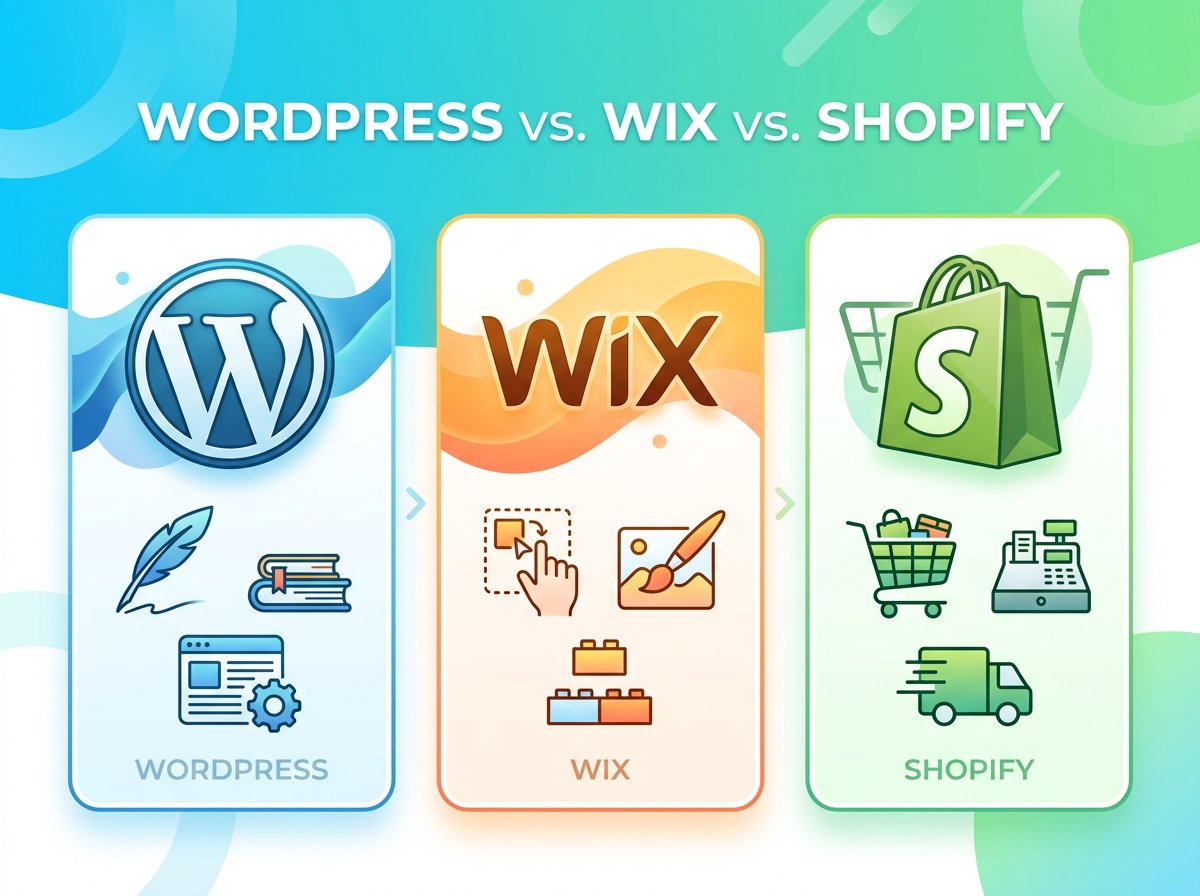
Three names dominate the conversation: WordPress, Wix, and Shopify. Each has passionate advocates, and each genuinely excels in different scenarios. This guide cuts through the noise and gives you an honest, side-by-side breakdown so you can make a confident, informed decision.
Quick answer: WordPress wins for flexibility and SEO power. Wix wins for simplicity and speed. Shopify wins for serious eCommerce. Read on to find out which one fits your specific situation.
Understanding Each Platform at a Glance
WordPress — The Open-Source Powerhouse
WordPress powers over 43% of all websites on the internet — a staggering statistic that speaks to its versatility. Originally launched as a blogging platform in 2003, it has evolved into a full content management system (CMS) capable of running anything from personal blogs to Fortune 500 company websites.
WordPress is open-source, meaning the software itself is free. However, you’ll need to pay for hosting, a domain name, and potentially premium themes and plugins. This gives you total ownership and control, but it also means more responsibility on your end.
Wix — The Drag-and-Drop Simplifier
Wix launched in 2006 with a singular mission: make website building accessible to everyone. With its intuitive drag-and-drop editor, Wix lets you design a professional-looking website without writing a single line of code.
It’s a hosted platform, meaning Wix handles servers, security updates, and infrastructure for you. You pay a monthly subscription and focus entirely on your content. For non-technical business owners who want to get online fast, Wix is often the first recommendation.
Shopify — The eCommerce Specialist
Shopify was purpose-built for online selling. Launched in 2006, it has grown into the world’s leading dedicated eCommerce platform, used by over 1.7 million businesses globally — from independent boutiques to enterprise-level brands.
Like Wix, Shopify is a hosted platform. It combines an easy-to-use interface with industry-leading eCommerce features: inventory management, payment processing, shipping integrations, and analytics baked right in. If selling products online is your primary goal, Shopify is engineered specifically for that.
Ease of Use — Who Wins for Beginners?
Let’s be honest: not every business owner wants to become a web developer. Here’s how the platforms compare when you’re starting from scratch.
WordPress
WordPress has a steeper learning curve than both Wix and Shopify. Setting it up requires choosing a hosting provider, installing the software, selecting a theme, and installing plugins for additional features. Once configured, it’s powerful — but the initial setup can be overwhelming for non-technical users.
That said, page builders like Elementor and Divi have dramatically simplified the WordPress experience, allowing drag-and-drop editing on top of the WordPress backend.
Wix
Wix is the clear winner for ease of use. The visual editor is intuitive, responsive, and fast. You can have a polished website live within a few hours, even if you’ve never built one before. Wix ADI (Artificial Design Intelligence) can even generate a website for you based on a few questions.
Shopify
Shopify sits comfortably in the middle. Setting up a store is straightforward, with guided onboarding that walks you through adding products, setting up payments, and customizing your storefront. The interface is clean and well-organized. Non-technical users can manage it confidently, though some advanced customizations may still require developer help.
Ease of use verdict: Wix > Shopify > WordPress — but WordPress’s learning curve is worthwhile if you need its power and flexibility.
Design & Customization — How Much Creative Control Do You Have?
WordPress
WordPress offers virtually unlimited design freedom. With thousands of free and premium themes, plus the ability to code custom designs from scratch, the sky is the limit. You can build any type of website — portfolio, magazine, membership site, directory, marketplace — and style it exactly as you envision.
If you’re working with a designer or developer (like the team at DannyPro), WordPress gives us the canvas to create something completely unique and on-brand, not constrained by platform templates.
Wix
Wix provides over 800 professionally designed templates, all fully customizable through its editor. You have considerable creative freedom — changing fonts, colors, layouts, and sections is quick and visual. However, Wix templates are not interchangeable once your site is live; switching templates requires rebuilding your site from scratch.
For most small businesses, Wix’s design options are more than sufficient. But if you need a truly bespoke design, you may hit its limits.
Shopify
Shopify’s design options are more focused than WordPress or Wix, which makes sense — it’s designed around selling, not storytelling. There are around 100 official themes (free and paid), and the theme editor allows meaningful customization. For advanced design changes, you’ll need to work in Shopify’s Liquid templating language, which requires developer knowledge.
The designs that come out of the box are clean, modern, and conversion-optimized — which is exactly what an eCommerce store needs.
Design verdict: WordPress wins for total creative control. Wix is great for polished results without a developer. Shopify’s designs are purpose-built to sell.
SEO Capabilities — Which Platform Ranks Better on Google?
Search engine optimization is critical for organic traffic. Here’s how each platform stacks up.
WordPress
WordPress is widely regarded as the best platform for SEO. With plugins like Yoast SEO or Rank Math, you get granular control over meta titles, descriptions, schema markup, XML sitemaps, canonical URLs, and more. You also have full control over your site’s code, loading speed, and URL structure — all of which matter to Google.
WordPress’s blog functionality is second to none, making content marketing and SEO-driven growth more achievable. Long-term, a well-optimized WordPress site tends to outperform the other platforms in organic search.
Wix
Wix has improved its SEO capabilities significantly in recent years. It now offers meta tag editing, structured data, auto-generated sitemaps, and its own SEO Setup Checklist to guide you. However, it still lags behind WordPress in technical SEO flexibility. Some limitations — like URL structure customization and page speed optimization — are harder to address on Wix.
Shopify
Shopify’s SEO is solid for an eCommerce platform. It automatically generates sitemaps, supports canonical tags, and allows you to edit meta data. However, it has some structural quirks — such as duplicate URLs for product pages and forced URL structures — that can create challenges for advanced SEO strategies. Apps like SEO Manager can help, but you’ll always have less control than on WordPress.
SEO verdict: WordPress is the strongest platform for long-term organic growth. Wix and Shopify are adequate but have notable limitations.
eCommerce Features — Which Platform Sells Better?
If selling products online is part of your business model, this section matters most.
WordPress (with WooCommerce)
WordPress doesn’t have eCommerce built-in, but the free WooCommerce plugin transforms it into a fully capable online store. WooCommerce powers around 28% of all online stores globally. It supports physical and digital products, subscriptions, bookings, and virtually any sales model you can imagine.
The trade-off: you’re responsible for managing hosting performance, security, and plugin compatibility. As your store grows, you may need developer support to keep everything running smoothly.
Wix
Wix includes built-in eCommerce tools that work well for small businesses selling a limited number of products. You can set up a store, accept payments, manage orders, and offer discount codes — all through a simple interface. However, Wix’s eCommerce features are less robust than Shopify for businesses with large inventories, complex shipping rules, or high sales volumes.
Shopify
Shopify is the undisputed eCommerce champion. It was built from the ground up for selling, and it shows. Shopify offers advanced inventory management, multi-channel selling (sell on Instagram, Amazon, TikTok, and your website simultaneously), abandoned cart recovery, built-in analytics, and a massive app ecosystem for extending functionality.
Transaction fees apply unless you use Shopify Payments, and the monthly costs can add up with premium apps. But for businesses serious about eCommerce growth, Shopify provides the infrastructure and scalability to support that journey.
eCommerce verdict: Shopify wins decisively. WooCommerce on WordPress is a close second for businesses wanting maximum flexibility. Wix works for simple, small-scale stores.
Pricing — What Will It Actually Cost You?
Here’s a realistic breakdown of what you’ll pay for each platform.
WordPress
- Software: Free (open-source)
- Hosting: $5–$30/month (shared hosting) to $50–$200+/month (managed WordPress hosting)
- Domain: ~$15/year
- Premium theme: $0–$100 (one-time)
- Essential plugins: $0–$200+/year depending on your needs
Total: Roughly $100–$500/year for a basic site, scaling up based on needs. WordPress can be very cost-effective or quite expensive — it depends on the complexity of your project.
Wix
- Free plan: Available (Wix branding displayed)
- Business plans: $17–$35/month (billed annually)
- eCommerce plans: $25–$35/month
Total: Roughly $200–$420/year for a professional business site. Wix pricing is predictable and straightforward, with no surprise add-ons.
Shopify
- Basic: $39/month
- Shopify: $105/month
- Advanced: $399/month
- Plus additional app costs, which can range from $0 to $200+/month
Total: $468–$1,200+/year before apps. Shopify is the most expensive of the three, but for a business generating significant eCommerce revenue, it’s a worthwhile investment.
Pricing verdict: WordPress is most flexible in cost. Wix is the most predictable. Shopify costs more but delivers specialized eCommerce value.
Which Platform Is Right for You? The Decision Framework
Here’s a simple way to think about it:
Choose WordPress if:
- You want maximum flexibility and long-term control over your website
- SEO and content marketing are core to your growth strategy
- You’re working with a web designer or developer to create something unique
- You have a complex website with multiple content types, memberships, or custom functionality
- You want to own your platform without being locked into a subscription
Choose Wix if:
- You’re a small business owner who wants a beautiful site up quickly
- You don’t have technical knowledge and want an all-in-one, easy platform
- Your site is primarily informational (about page, services, contact, blog)
- Budget predictability matters and you want no surprises
- You’re a creative professional, freelancer, or local service business
Choose Shopify if:
- Selling products online is your primary business model
- You have a large or growing product catalogue
- You need multi-channel selling across social platforms and marketplaces
- You need built-in inventory management, shipping, and sales analytics
- You’re ready to invest in a platform built to scale your revenue
A Note from Danny
After 10 years of building websites for startups and businesses, I’ve worked extensively with all three platforms. My honest take: the right platform is the one that aligns with your specific goals, technical comfort level, and budget — not the most popular one or the one your competitor uses.
I’ve seen WordPress sites rank on the first page of Google within months. I’ve seen Wix sites convert visitors into clients beautifully. I’ve helped Shopify stores scale from zero to six figures. The platform is a tool — what matters most is the strategy, design, and execution behind it.
If you’re unsure which direction to go, I offer free consultations to help you make the right call before you invest in anything. Reach out at Info@dannypro.io and let’s talk about your specific situation.
Final Verdict
There’s no universally “best” platform — only the best one for your needs. To recap:
- WordPress: Best for SEO, flexibility, and complex custom websites
- Wix: Best for simplicity, speed, and non-technical business owners
- Shopify: Best for eCommerce and scaling an online store
Whatever you choose, invest in a solid design and clear messaging. A well-designed website on any of these platforms will outperform a poorly designed one every time.
Ready to build something great?
Visit dannypro.io or email Info@dannypro.io to get started. Whether you need a new website, a redesign, or just expert advice, I’m here to help.